

It’s almost 2 years since I first created a video clone of myself and 8 months since I created an interactive avatar.
Time for a check-in to see how the tech has developed and which avatar generator can create the most lifelike version of me.
I focussed on tools which can create reusable likenesses of real individuals, capable of voicing whatever text you provide them with.
My assessment was based on four key criteria: visual likeness, audio likeness, movement and lip syncing.
Here’s how they got on:
HeyGen
Avatars are HeyGen’s sole focus, so it’s perhaps unsurprising it offers a (slightly confusing) range of options for generation. Avatar IV has the lowest barrier to entry, requiring just a single photo, but I decided to assess HeyGen on its custom video avatar, which you can generate, with a HeyGen watermark, without parting with any cash.
It’s Creator plan, which costs $29pm ($24pm for annual plan), enables you to create 10 photo avatars, one custom video avatar and one interactive custom avatar (additional video and interactive avatars cost $29pm and $49pm, respectively).
The avatar creation and video generation process were both straightforward and I took advantage of the ability to slightly slow down the pace of my voice clone.
Here’s my first generation:
I was pretty impressed by this. The video likeness, movement and lip syncing are all excellent and the voice likeness isn’t bad. The ‘hi’ has a slightly robotic edge, but the rest of it could plausibly be a recording of me.
Strengths:
Excellent video likeness, with natural movement and decent lip syncing
Quick to generate avatars and videos
Fine grain controls to finesse voice clone
Optional ElevenLabs integration for higher quality voice clones
Weaknesses:
Expensive if you want to create more than one avatar
Cost: free to create watermarked avatar, paid plans from $29pm ($24pm for annual plan)
Inputs: photo or 30s-10m video
Time to generate avatar: ~6 mins
Time to generate videos: ~2 mins
Aspect ratios: 16:9, 9:16
Consent: video
Visual likeness: ⭐⭐⭐⭐⭐
Audio likeness: ⭐⭐⭐⭐
Lip syncing: ⭐⭐⭐⭐
Movement: ⭐⭐⭐⭐⭐
Overall rating: ⭐⭐⭐⭐
Synthesia
Founded in 2017, Synthesia is one of the UK’s most statuesque AI unicorns, with a valuation in excess of $2bn.
Avatar creation requires the Starter plan which costs £23pm (£14pm for annual plan) and enables you to create 3 personal avatars and create 120 minutes of video a year.
Synthesia’s default avatars are impressive, so I had high hopes for my personal avatar, which went up further when I was told my avatar would take until tomorrow to be ready.
However, I was a bit underwhelmed with my finished avatar’s generations.
The video likeness is decent, but the voice likeness comes and goes and the movement and lip syncing both feel a bit off.
Strengths:
Competitively priced annual Starter plan with generous 3 personal avatar allowance
Weaknesses:
Slow avatar generation
Unnatural mouth movement
Cost: free 30 day trial, paid plans from £23pm (£14pm for annual plan)
Inputs: 5+ photos or 2+ min video
Time to generate avatar: ~12 hours
Time to generate videos: ~10 mins
Aspect ratios: 16:9
Consent: video
Visual likeness: ⭐⭐⭐⭐
Audio likeness: ⭐⭐⭐
Lip syncing: ⭐⭐
Movement: ⭐⭐
Overall rating: ⭐⭐⭐
AI Studios
Developed by DeepBrain AI, AI Studios enables you to create a custom avatar and generate three 3-minute watermarked videos for free.
The welcome video invites you to “transform yourself into a custom avatar in just 2 minutes!”
Generating my avatar did appear to take 2 minutes, but generating my first video with it took a whopping 80 minutes, suggesting my avatar wasn’t fully generated.
The visual likeness is fairly credible but the voice doesn’t sound like me and some of the movement looks unnatural.
Strengths:
Quick avatar generation
Decent visual likeness
Weaknesses:
Slow video generation
Poor audio likeness
Unnatural movement
Cost: 3 x 3 min videos free, paid plans from $29pm ($24pm for annual plan)
Inputs: 2 mins of video
Time to generate avatar: ~2 mins
Time to generate videos: ~80 mins
Aspect ratios: 16:9, 9:16
Consent: digital signature
Visual likeness: ⭐⭐⭐⭐
Audio likeness: ⭐⭐
Lip syncing: ⭐⭐⭐
Movement: ⭐⭐⭐
Overall rating: ⭐⭐⭐
Mirage Studio
Launched last month by NYC-based startup Captions, Mirage Studio is aimed at “marketers and creative teams” and positions itself as a direct alternative to using real people to record talking-head videos. Their website copy certainly doesn’t take any prisoners. The section ‘Why Mirage Studio beats traditional video production’ includes “No freelancers, no contracts, no 1099s — just a self-serve content pipeline.”
The process of creating a video starts by uploading or recording some audio or writing a script, which can be read by any one of 50 voices from OpenAI, ElevenLabs, Google and Cartesia or by your own voice clone, which you create by reading a short script.
Mirage Studio analyses the audio and suggests when to make jump cuts (a necessity, as it can’t create shots longer than 4s). You then get to pick an existing ‘actor’ from their ‘audition’ video or generate a new one from an image or text description.
I created a new ‘actor’ from a still image of me taken from the video I uploaded to the generators that would accept a video.
Here’s the resulting avatar:
I was pleasantly surprised by the naturalness of the movement and the quality of the lip syncing. The voice is a little cor blimey guvnor. However, it’s the jump cut after 4 seconds that’s the dealbreaker. I’d like to think it’s only a matter of time before Captions develops or integrates a model capable of generating longer shots.
Strengths:
Quick avatar and video generation
Credible movement and lip syncing
Weaknesses:
4 second shot limit creates jump cuts
9:16 portrait videos only
Expensive paid plan
Cost: free to generate avatar with limited monthly credits to generate videos, paid ‘business’ plan: $399 a month
Inputs: 1 photo and ~30 second audio recording
Time to generate avatar: ~4 mins
Time to generate video: ~5 mins
Aspect ratios: 9:16
Consent: ‘agree and continue’ button on first login
Visual likeness: ⭐⭐⭐
Audio likeness: ⭐⭐
Lip syncing: ⭐⭐⭐⭐
Movement: ⭐⭐⭐
Overall rating: ⭐⭐ (due to 4 second jump cuts)
Argil
Targeting a similar market to Mirage Studio, Argil promises “a perfect video for social media of you or a generic avatar in 2 minutes”.
Like Mirage Studio, it suffers from jump cuts as a result of short clip generations. However, the cuts come twice as often - every 2 seconds - which makes the output even less usable.
I did appreciate that it provided me with two voice options to choose from, although the subsequent voice generation failed on my first few attempts.
The voice, visual likeness and movement aren’t bad, however the lip syncing is unconvincing.
Strengths:
Reasonable voice and visual likeness
Weaknesses:
Jump cuts make it unusable for most use cases
Expensive
Cost: 5 day free trial, from $39pm ($325pa for annual plan)
Inputs: 2-5 mins video
Time to generate avatar: ~14 hours
Time to generate videos: ~10 mins
Aspect ratios: 16:9, 9:16
Consent: video
Visual likeness: ⭐⭐⭐⭐
Audio likeness: ⭐⭐⭐
Lip syncing: ⭐⭐
Movement: ⭐⭐⭐
Overall rating: ⭐⭐ (due to 2 second jump cuts)
D-ID
D-ID lets you create an ‘Express Avatar’ for free, although you can only generate short (10 word) watermarked videos without ponying up $29pm ($16pm for annual plan).
After viewing my first generation, I wasn’t inclined to fork out for the paid monthly plan.
The visual likeness is ok but the lip syncing and audio likeness are both pretty terrible, with more than a hint of Sean Connery in the delivery of “Dan here”.
Strengths:
Quick video generation
Weaknesses:
Poor audio likeness and lip syncing
Cost: 14-day free trial (1 avatar, 12 generations with 10 word script) then from $29pm ($16pm for annual plan)
Inputs: photo or 30s-5m video
Time to generate avatar: ~15 mins
Time to generate videos: ~2 mins
Aspect ratios: 16:9, 9:16, 1:1
Consent: video
Visual likeness: ⭐⭐
Audio likeness: ⭐
Lip syncing: ⭐
Movement: ⭐⭐
Overall rating: ⭐⭐
Colossyan
Uniquely amongst the generators I tested, Colossyan asks for 20 seconds of audio-free, mouth-closed video and a separate 15+ second audio recording.
I was intrigued as to how it would infer the way I talk from the two inputs. Sadly, the output brought to mind Annoying Orange.
Strengths:
Um….a reminder that avatar generation isn’t a piece of cake?
Weaknesses:
Comically bad lip syncing
Cost: 2 week free trial with 5 mins of video, then from $27pm ($19pm for annual plan)
Inputs: 1 photo or 20 seconds of audio-free video and 15+ second audio recording
Time to generate avatar: ~5 mins
Time to generate videos: ~6 mins
Aspect ratios: 16:9, 9:16, 1:1, custom
Consent: check box
Visual likeness: ⭐⭐
Audio likeness: ⭐⭐
Lip syncing: ⭐
Movement: ⭐
Overall rating: ⭐
Conclusions
Generating convincing avatar clones of real people is difficult and the human eye and ear are unforgiving of anything that’s slightly off.
HeyGen is still #1, although its voice likenesses remain imperfect and not a huge step on from 2 years ago.
Generating convincing voice likenesses appears to be more challenging than video likenesses, with ElevenLabs lead in this domain very apparent.
Some new entrants are betting that very short clips will be sufficient for many content creators (or that they’ll hang around/come back once the models can deliver longer generations without jump cuts).
Whilst the quality hasn’t significantly improved from the high bar HeyGen set two years ago, I’m confident we’ll see avatar clones that are indistinguishable from the real deal in the not too distant future. I anticipate those clones are increasingly going to be plumbed into persona-based chatbots popularised by platforms such as Character.AI, Replika and Delphi, enabling real-time video conversations with plausible facsimiles of real people. Whilst one or two start-ups might achieve scale in this domain, I expect Meta, xAI and ByteDance will lead the mainstream charge into these ethically problematic waters.
As with AI video generation more generally, I suspect we may look back with a degree of nostalgia at a time when AI avatars were easy to spot and sometimes comically bad.
See you back here in 2 years time to discuss.
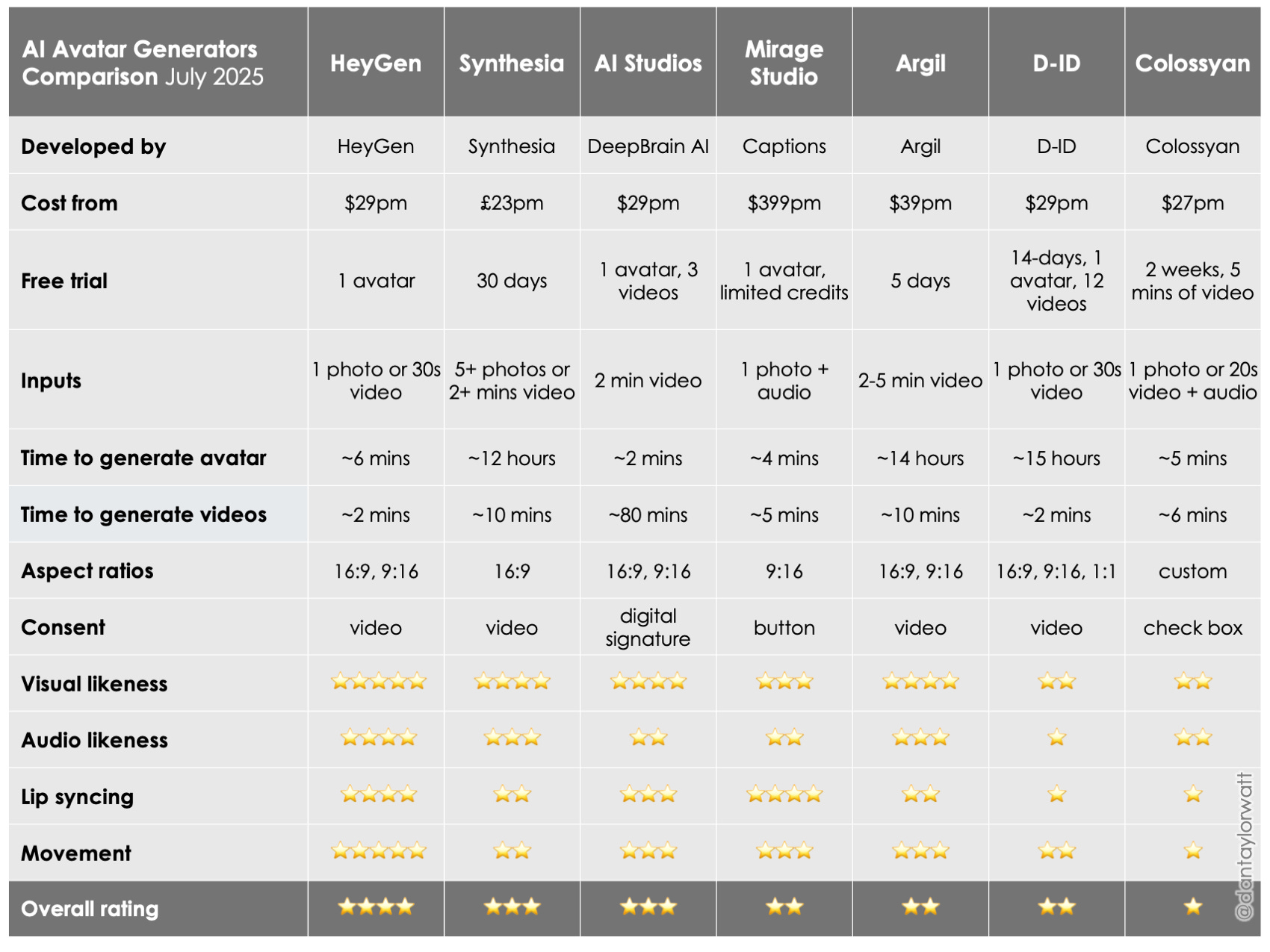
At a glance comparison
Hey Dan. Thx for going through all the work to do this. I agree HeyGen's was the best. And all of this will only get better, right!?